


Cognitive Load in Engagement
Updated: Apr 2

Think back to a time you felt under pressure to make a decision. What did the pressure do to your ability to process information?
You might notice that pressure, stress or some other heightened emotional states reduces our the ability to process information. This is critical when it comes to engagement.
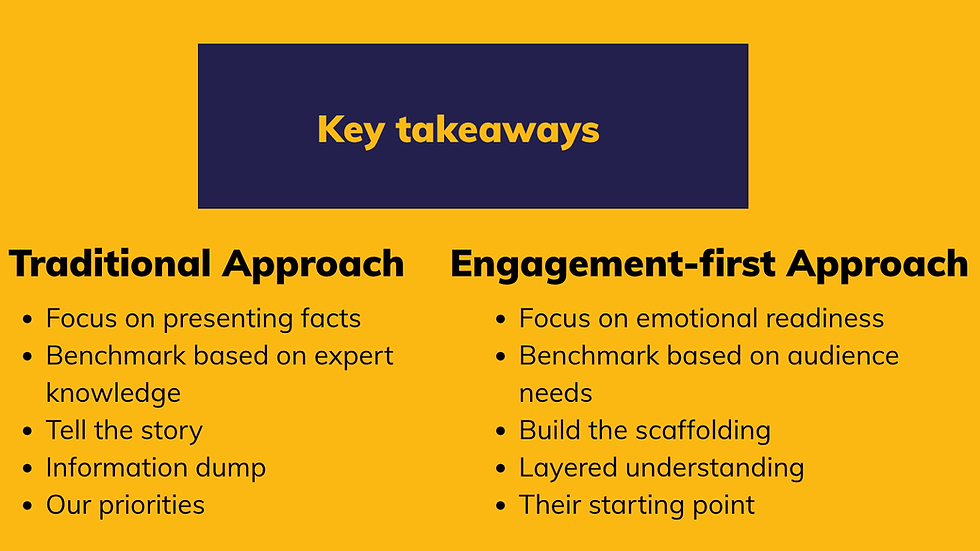
If our emotional state impacts cognition, then we need to ask, “Why do we focus so much on presenting the ‘facts’, without factoring in the emotional state of the people we want to understand said ‘facts’?”
When we do this, the people we engage end up feeling overwhelmed, and the organisation doing the engagement can’t work out why ‘those people just don’t get it’.
To be clear, people need information to be able to give meaningful input, but when the benchmark for what they ‘need’ is set by someone immersed in the project for the last 12 months, you get the holiday photo dilemma.
If you have ever listened to someone go on about their latest overseas holiday, you know there is a massive gap between what is important for you to hear and what the person showing you the 100th photo of the same sunset thinks is important.
This difference is subtle but critical. If your focus is ‘telling the story’, then you are the person with the 100 sunset photos. Yes, there is skill in whittling down the number of photos, but your ‘need’ still takes the priority.
When the communication aspect of engagement focuses on ‘telling the story’ or, ‘defining the narrative’. It can miss the engagement lens that would ask “who is receiving the information and what do they need?”
If your focus is engagement, the other person’s world (emotions, stress, cultural difference etc) is the starting point. Appreciate this and scaffolding content becomes simpler. Bit like a painting, you need to sketch the outline, before filling in the colour.
Cognitive load or more accurately, cognitive OVERLOAD, happens when we prioritise telling or selling our story, over the needed scaffolding.
In both instances the usual communication ‘ingredients’ apply
A bit like being able to make any number of different types of bread from the dame basic ingredients, it’s not just the ‘ingredients’ (white space, simple language, plenty of visuals), the real skill is in how to mix those ingredients
A Final Thought
Effective engagement isn't about how much you say - it's about how well they can receive it!


Comments